Yesterday I came across a post in Threads (https://www.threads.com/@xin_n2025/post/DcoIurfgWDA) about the pronunciation of the Chinese character 血.
As old Chinese dictionaries are hard to find nowadays and only a few of them have been digitized, I’ll use dictionaries published by Westerners to give a better picture with a slight touch on sound changes over the time. In my recall that in my childhood years it was said that ㄒㄩㄝˇ is the reading sound (讀音) and ㄒㄧㄝˇ is the spoken sound (語音).
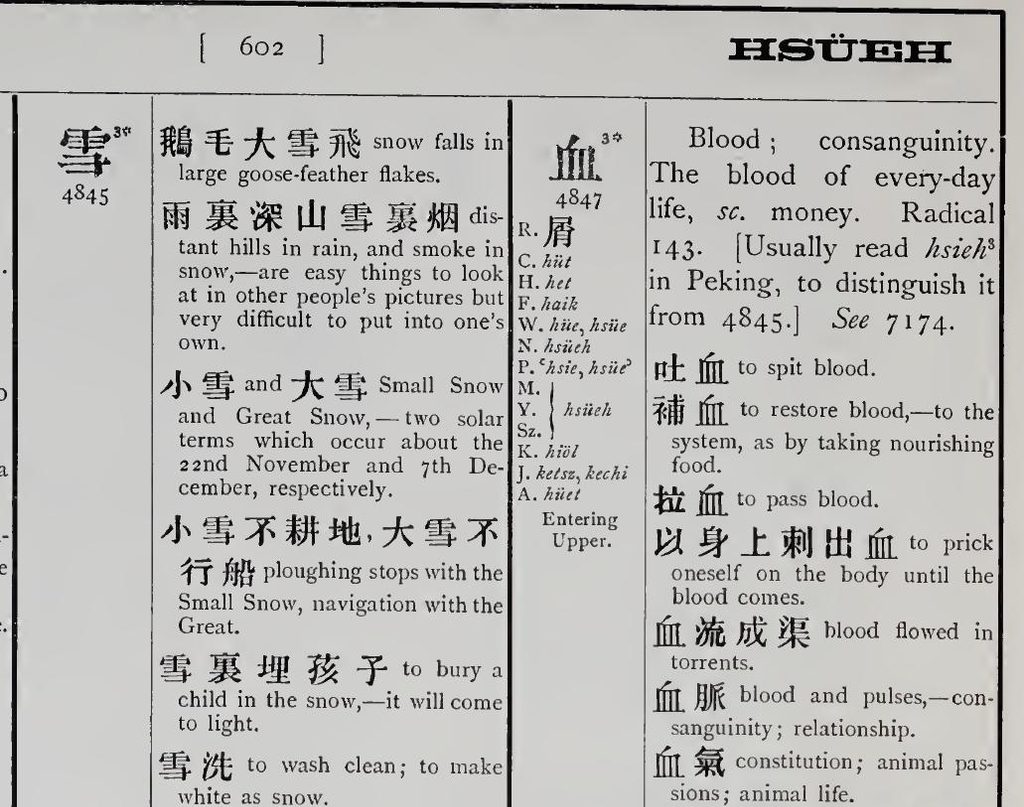
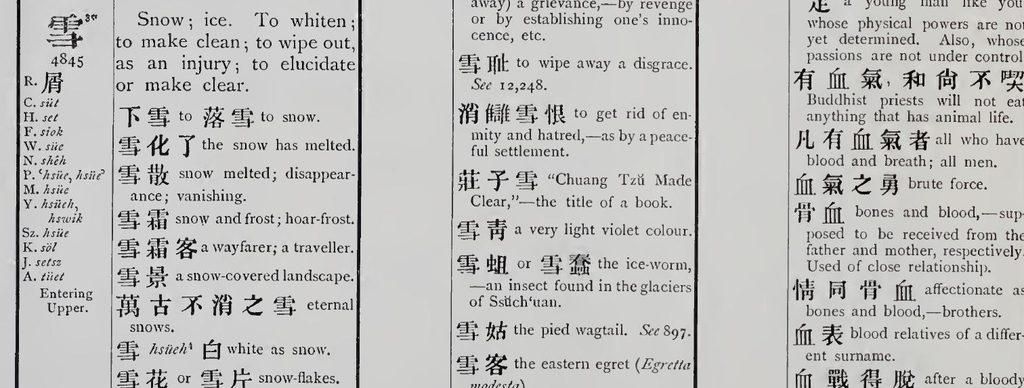
The following two screenshots are from A Chinese-English Dictionary by Herbert A. Giles, Second Edition (1912). The first edition was published in 1892 and the preparation of the first edition took about 18 years. So the pronunciations presented should reflect the sounds around mid-19th century. Herbert Giles is the Giles in Wade-Giles Romanization. The Romanization hsüeh3 corresponds to ㄒㄩㄝˇ in bopomofo. In 血3* as shown in the screenshot, 3 denotes the 3rd tone, and * means it originally was a 入聲. You can see it also says [Usually read hsieh3 in Peking, to distinguish it from 4845]. Hsieh3 corresponds to ㄒㄧㄝˇ in bopomofo. 4845 refers to word 4845 and happens to be 雪 as can be seen on the left or in the screenshot next to it.
You can find A Chinese-English Dictionary (v.2) at https://ia803102.us.archive.org/11/items/chineseenglishdi02gile/chineseenglishdi02gile.pdf and v.1 at https://ia803106.us.archive.org/20/items/chineseenglishdi01gile/chineseenglishdi01gile.pdf.
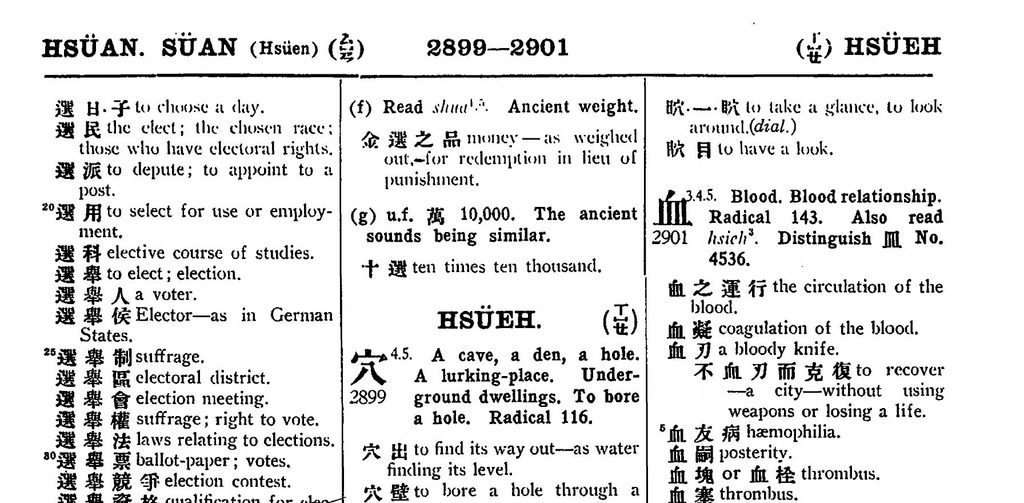
The following screenshot is from Mathew’s Chinese-English Dictionary, Revised American Edition (1943). The original edition was published in 1931. In the screenshot it shows it’s also hsüeh and 血3.4.5. , and 3 and 4 mean the third and fourth tones, with 5 denoting 入聲. So around the 1930s the fourth tone was already emerged. This basically fits the phonological rule of 上聲變去聲. In the screenshot it also says “Also read hsieh3” and this also fits Giles’ words.
The said dictionary is available at https://archive.org/details/mathewschineseen00math/page/n1255/mode/2up (You can only borrow it now).
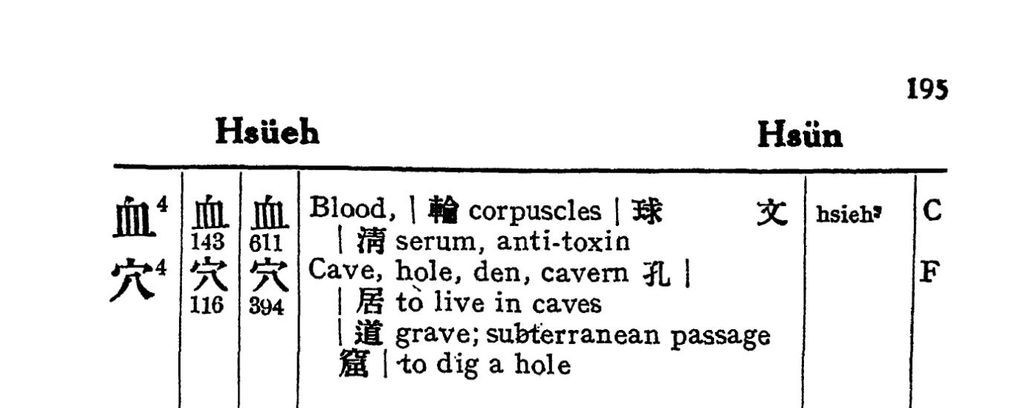
You can also check 血 in The Five Thousand Dictionary, first published in 1940 from the following link.
In this dictionary it is hsueh4 for the spoken sound and hsieh? (tone not legible/decipherable, very likely to be the 3rd tone) for the reading sound. I do have the paper edition of this dictionary, but it’s still inside one of the many cardboard boxes of mine that have not been unpacked for years.
/
